Round Brilliant Lab-Grown vs Natural Diamond
Round brilliant is the most-shopped diamond shape in both lab-grown and natural markets and accounts for the majority of engagement-ring centre-stone volume. The shape carries a small price premium over fancy shapes at the same weight, has the most standardised cut-grading methodology, and is the category in which most laboratory grading reports apply their fullest analytical apparatus. This page walks through the round brilliant comparison on cut-grade, proportions, certification, and the price premium relative to other shapes.
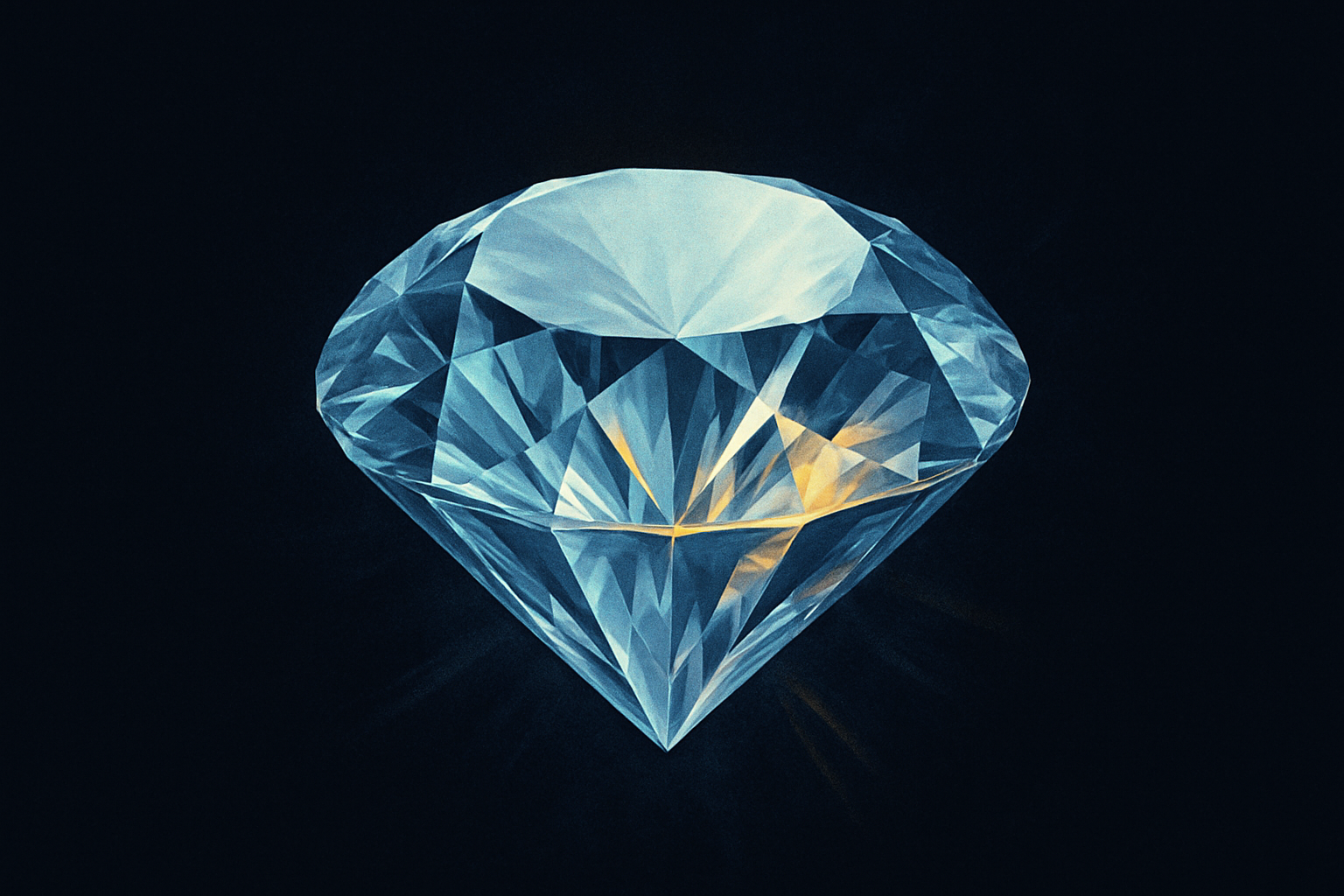
Round brilliant cut viewed from a slight elevation, showing the table facet and the crown facet pattern. The proportions framework was formalised by Marcel Tolkowsky in 1919 and remains the basis of modern cut grading.
The dominance of round brilliant
Round brilliant accounts for the majority of engagement-ring centre-stone purchases in mainstream United States retail and is the modal shape across most international jewellery markets. Trade-press reporting consistently identifies round brilliant as the most-shopped shape, with fancy-shape combined volume sitting in a substantial minority share3. The dominance is durable: round brilliant has been the modal engagement-ring shape for decades and the share has not been displaced even as fancy-shape preferences have grown in some segments.
The dominance derives from several reinforcing factors. The proportions of the round brilliant cut, developed by Marcel Tolkowsky in 1919 and refined in subsequent decades, produce the highest standardised light return of any common cut6. The retail-marketing legacy of round brilliant as the engagement-ring shape goes back to the early twentieth century. The grading apparatus of GIA, IGI, and other laboratories is most fully developed for round brilliant, which gives buyers the most directly comparable specifications across stones and retailers.
For lab-grown stones, round brilliant has the same dominance. Lab-grown production of round brilliant stones is the largest single category by volume, and most lab-grown engagement-ring purchases default to round brilliant in the same proportions as natural purchases do. The category does not change the shape preferences materially; it changes the price for any given shape.
| Attribute | Lab-Grown | Natural |
|---|---|---|
| Cut-grade scale | Excellent / Very Good / Good / Fair / Poor | Excellent / Very Good / Good / Fair / Poor |
| Wholesale ratio (G VS1) | ~14% of natural | Reference |
| Retail ratio (G VS1) | ~30% of natural | Reference |
| Modal certification | IGI (4Cs) | GIA full Grading Report |
| Hearts and Arrows availability | Common in higher tiers | Common in higher tiers |
Wholesale and retail ratios from Bain Global Diamond Industry Report (2021-22)2; cut-grade scales from GIA published methodology1.
Cut grading on round brilliant
Round brilliant is the only shape for which GIA reports a quantitative cut grade derived from measured proportions1. The cut grade is a function of table percentage, depth percentage, crown angle, pavilion angle, girdle thickness, polish, and symmetry, with the categories Excellent, Very Good, Good, Fair, and Poor reflecting how closely the stone's proportions match the ranges that produce optimal light return.
The Excellent grade covers a band of acceptable proportional ranges rather than a single ideal point. Within Excellent, there is room for genuine variation in how a stone presents under different lighting, and a buyer comparing two Excellent-cut round brilliants of the same weight and grade may find one slightly more lively than the other. The Hearts and Arrows pattern, visible under a specialised viewer, is a narrower optical-symmetry indicator within the Excellent band.
The cut-grade differential between Excellent and Very Good is visible to most observers under jeweller's lighting; the differential between Excellent and Good is visible under almost any lighting. The price premium for Excellent over Very Good is modest in both lab-grown and natural categories and the buyer who specifies Excellent generally captures the visible-quality gain without large budget movement. The case for Excellent cut on round brilliant is essentially the same in both categories.
For lab-grown round brilliants graded by IGI, the same Excellent / Very Good / Good / Fair / Poor scale applies, with similar proportional ranges and similar interpretive thresholds. The IGI cut grading on round brilliant is broadly comparable to GIA cut grading at the broad categorical level, though calibration on borderline stones may differ. A 2026 GIA Premium-tier report on a lab-grown round brilliant does not include the traditional cut-grade descriptor; it includes a separate light-performance assessment within the Premium / Standard tier framework.
The shape-price premium
Round brilliant carries a small price premium over fancy shapes at the same weight and grade. The premium derives from the cutting-yield difference: a round brilliant typically uses thirty to forty per cent of the rough crystal by mass, while elongated fancy shapes (oval, pear, marquise) use forty to sixty per cent because their elongated proportions can follow more of the natural rough shape. The yield loss is built into the polished-stone price.
The premium varies by shape, by weight band, and by market conditions. At one carat in natural, round brilliant typically carries a five to fifteen per cent premium over oval at the same grade. At two carat the premium is similar. For lab-grown stones the premium pattern is broadly similar in percentage terms, though the absolute dollar premium is much smaller because the base price is lower.
The buyer's translation is that for any given budget, a fancy-shape stone delivers slightly more visible weight than a round brilliant. A buyer prioritising visible-size impact over the round-brilliant aesthetic may favour oval, pear, or marquise to capture this premium. The shape comparisons are in the other by-shape guides.
Proportions to look for
The GIA Excellent cut grade on round brilliant covers a range of table percentages from roughly fifty-three to fifty-eight per cent, depth percentages from roughly fifty-nine to sixty-three per cent, crown angles from roughly thirty-three to thirty-six degrees, and pavilion angles from roughly forty point six to forty-one point eight degrees. Within these ranges, individual stones present with varying degrees of brilliance, fire, and scintillation, and the buyer's eye is the final arbiter at the counter.
Stones that fall just outside the Excellent range (Very Good) may still present cleanly but typically show reduced light return under certain lighting conditions. A Very Good with a steeper crown angle or deeper pavilion will present with slightly more concentrated bright-light contrast and slightly less surface brilliance than an Excellent. The aesthetic preference for one or the other is individual; the cost saving from Very Good over Excellent is modest.
For lab-grown round brilliants, the same proportions framework applies. There is no category-specific adjustment to cut-grading. A lab-grown round brilliant with measurements that fall in the Excellent range is graded Excellent and presents like a natural Excellent of the same proportions. The cutting labour and standards are the same across categories.
Certification on round brilliant
For a natural round brilliant, GIA is the standard certification choice across all weight bands above half-carat. The GIA full Grading Report (with clarity plot) is typical from one carat upward, the Dossier format is acceptable below one carat. The pricing reference for natural round brilliant is calibrated to GIA grades and the secondary-market liquidity at GIA grades is the highest in the market.
For a lab-grown round brilliant, IGI is the most common choice and the easiest cross-shopping format. A 2026 GIA Premium-tier report is credible at this shape and is more readily issued on lab-grown round brilliant than on fancy shapes because GIA's grading apparatus is most fully developed for round brilliant. A GCAL 8X report adds quantitative light-performance metrics on top of the 4Cs and is a reasonable choice for buyers prioritising cut-quality metrics at this shape; GCAL light-performance grading is most fully developed for round brilliant.
The certification choice on round brilliant has more options than on most fancy shapes precisely because round brilliant is the most-graded shape across all laboratories. The full per-laboratory comparison is in the Certifications reference; the round brilliant choice is essentially a matter of which laboratory's calibration and reporting format the buyer prefers.
The round brilliant decision frame
For a buyer choosing the round brilliant shape, the lab-grown versus natural decision frame is the cleanest of any shape comparison because the standardised cut-grading and the dense laboratory data give the buyer the most directly comparable specifications across categories. A lab-grown round brilliant G VS1 Excellent IGI and a natural round brilliant G VS1 Excellent GIA can be compared on the spec sheet with high confidence that the stones are like-for-like in everything except the lab-versus-mantle origin and the price.
The cleanness of the comparison is what makes round brilliant the shape on which the lab-grown share gain has been most measurable. The category mix in round brilliant at the one-carat tier has shifted substantially toward lab-grown between 2020 and 2024, with the share gain concentrated in the most-shopped grade bands (G-H VS1-VS2 Excellent). The natural round brilliant market has compressed in volume but retained its position in the higher grade bands and in the resale-conscious buyer segment.
For a buyer in the round brilliant decision frame, the practical step is to compare stones at the same grade, the same weight, and the same cut grade across both categories. The price difference will be the Bain ratio of roughly thirty per cent retail, the visible quality will be identical, and the trade-off is then values-based: resale, narrative, ethics, and personal preference. The ethics framing chapter walks through that trade-off in structured form.
Cross-references
For other shapes: oval, princess/cushion/radiant cluster, emerald and asscher step cuts, and pear/marquise/heart fancies. For carat-specific considerations on round brilliant, the per-carat guides apply: half-carat, one-carat, two-carat, and onward. For the 4Cs grading framework, see Chapter 3.
Frequently asked
Why is round brilliant the most popular shape?
Is the lab-grown discount the same on round brilliant as on fancy shapes?
Why does round brilliant cost more than oval at the same weight?
Does cut grade matter more on round brilliant than on other shapes?
Is 'Hearts and Arrows' worth the premium on round brilliant?
Sources for this chapter
- GIA: Cut Grading for Standard Round Brilliant Diamonds - last verified May 2026
- Bain & Company: A Brilliant Recovery Shapes Up: The Global Diamond Industry 2021-22 (11th annual report) - last verified May 2026
- Rapaport: RAPI index, round brilliant grid - last verified May 2026
- IGI: Laboratory Grown Diamond Reports - last verified May 2026
- GCAL by Sarine: GCAL 8X light-performance grading - last verified May 2026
- Marcel Tolkowsky: Diamond Design (1919), original brilliant-cut proportions - last verified May 2026