Pear, Marquise, and Heart Lab-Grown vs Natural Diamond
Three distinctively shaped fancies share a market segment of buyers who want a centre stone that is visibly different from round or oval. Pear is teardrop-shaped with a single point; marquise is elongated-almond with two points; heart is symmetric with a central cleft. All three demand more symmetry attention than other shapes, can show bowtie or similar central dark areas if poorly cut, and have specific durability considerations at their points. This page walks through the three together because they share a buyer base and the cross-shopping considerations are similar.
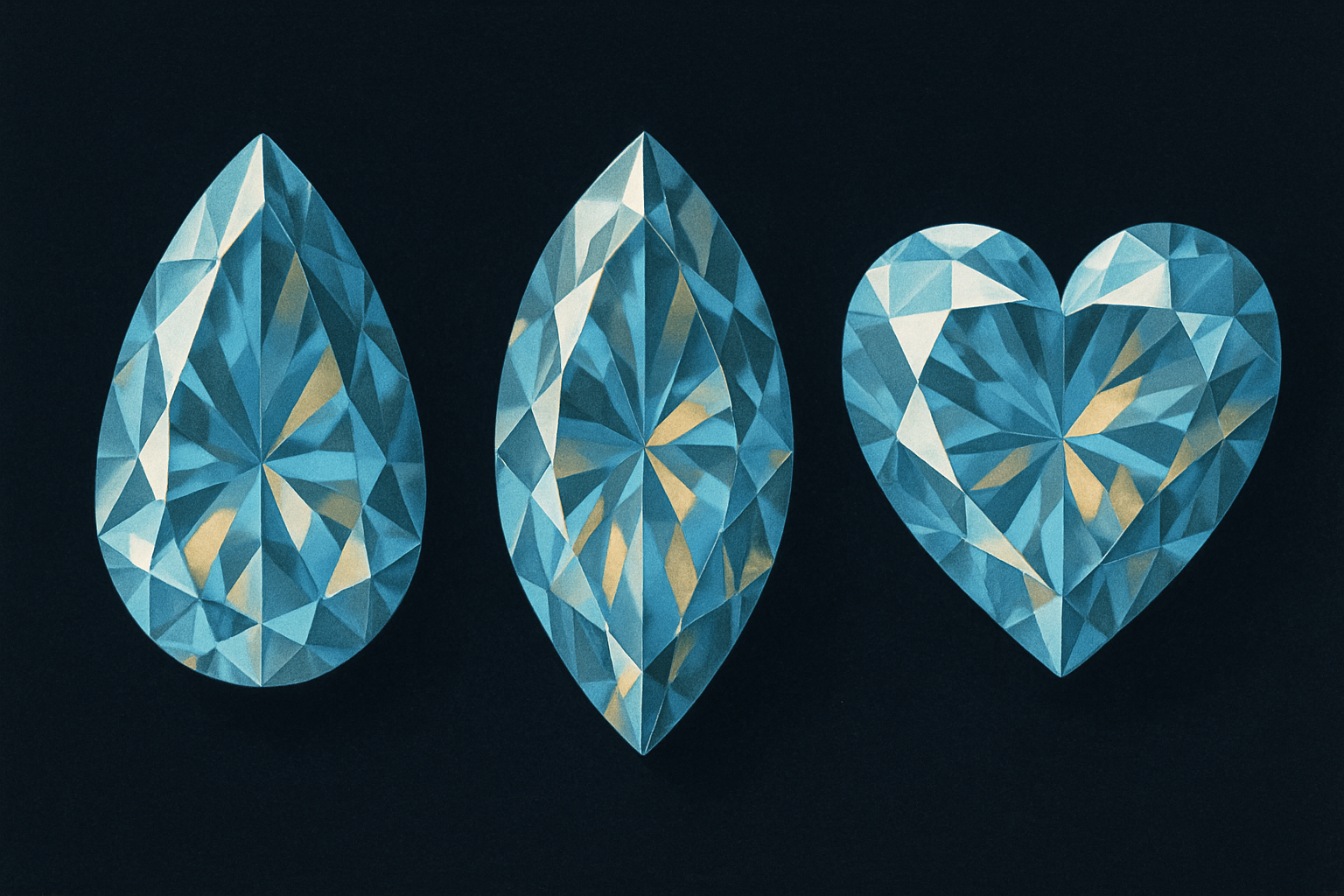
Left: pear shape with a single pointed tip. Middle: marquise with elongated almond outline and two sharp points. Right: heart shape with central cleft and symmetric lobes.
A shared minority segment
Pear, marquise, and heart together hold a meaningful but minority share of the diamond engagement-ring market. JCK and National Jeweler trade reporting consistently puts the three combined at a smaller share than oval and a much smaller share than round brilliant4. The buyers who choose any of the three are typically design-conscious and looking for a centre stone that is recognisably distinctive without being eccentric.
The three shapes share several characteristics that justify treating them together. All three have visible asymmetry as a defect risk; all three demand more visual inspection than round brilliant or the square-family fancies; all three have point or cleft features that affect durability and setting choice. The technical buyer-attention requirements are similar across the three, even though the aesthetic outcomes are distinctly different.
For lab-grown stones in any of the three shapes, availability is adequate but somewhat thinner than at the more mainstream shapes. Lab-grown production has been concentrated in round brilliant and the higher-demand fancy shapes (oval, princess, cushion), and the smaller-share shapes have less inventory depth. A buyer cross-shopping a specific grade-and-weight specification across multiple retailers may find fewer options on heart shapes in particular.
| Shape | Outline | Critical feature | Durability concern |
|---|---|---|---|
| Pear | Teardrop, single point | Point symmetry, bowtie | Point chipping (V-prong) |
| Marquise | Elongated almond, two points | Point matching, bowtie | Two-point chipping (V-prong) |
| Heart | Symmetric with central cleft | Lobe symmetry, cleft depth | Cleft and lobe-tip stress |
Shape descriptions and durability concerns from GIA fancy-shape guidance1 and standard setting-practice trade-press4.
Pear shape specifics
Pear is the most-popular of the three fancies and combines a brilliant facet pattern with a teardrop outline ending in a single point. The shape has an elongation similar to oval but with one rounded end and one pointed end, which gives it more visual movement than oval. The most-shopped length-to-width ratio range is roughly 1.50:1 to 1.75:1, with around 1.60:1 being modal.
The bowtie effect on pear is similar to oval, with the central dark area being a function of pavilion geometry and light leakage. A faint bowtie is normal; a prominent bowtie meaningfully reduces the stone's presentation. The bowtie assessment is visual and is the primary cut-quality variable that the buyer should check directly. Pear also has a symmetry concern at the point: the point should be centred on the long axis of the stone, and any drift off the centre line is visible.
Durability at the point requires a V-prong setting that covers and protects the point during wear. A standard prong setting leaves the point exposed and risks chipping under impact. The V-prong is the standard solution and most pear-shape engagement-ring settings incorporate it as a design feature. The orientation of the stone (point up toward the wearer's fingernail or point down toward the wearer's wrist) is an aesthetic choice with no consensus right answer.
Lab-grown pear inventory in 2026 is adequate across common ratio ranges and grade tiers. The lab-grown-to-natural ratio at common specifications matches the Bain category averages closely. Cross-shopping lab-grown pear is straightforward at the one to two carat band; the three carat and above band has thinner lab-grown inventory but still has options.
Marquise shape specifics
Marquise has an elongated almond outline with brilliant facets and two sharp points at the ends. The shape was reportedly commissioned by Louis XV of France in 1745 and named for the Marquise de Pompadour, with the original cut intended to evoke the shape of her lips5. The historical association gives marquise a distinct character among fancy shapes.
The length-to-width ratio range for marquise is roughly 1.75:1 to 2.25:1, with around 1.85:1 to 2.00:1 being the most-shopped band. The shape elongates the finger more strongly than oval or pear because of its higher elongation ratio. The visual presence per carat is among the highest of any common shape: a one-carat marquise reads as a much larger stone than a one-carat round brilliant because the carat mass is distributed over a longer visible top surface.
The bowtie effect on marquise can be prominent because the high elongation ratio amplifies the central light-leakage issue. A well-cut marquise has a manageable bowtie; a poorly cut marquise has a prominent and distracting bowtie. The two points must be symmetric in their projection from the body of the stone; any mismatch in point geometry is visible and reduces the stone's presentation.
Both points require V-prong settings for chip protection. The standard marquise engagement-ring setting incorporates V-prongs at both ends as a design feature. Marquise is well-suited to vintage and modern settings alike and has had periodic revivals in mainstream demand. Lab-grown marquise inventory in 2026 is adequate at common specifications, with the high-elongation ratios being the most-cut variant.
Heart shape specifics
Heart is the most explicitly symbolic of the three shapes and is therefore the most narrowly chosen. The shape has a central cleft at the top of the heart and symmetric lobes flanking the cleft, with the bottom of the heart tapering to a single point. The brilliant facet pattern follows the heart outline.
Symmetry is the dominant cut-quality consideration on heart. The two lobes must match in size and outline, the cleft must be centred, and the bottom point must align with the central axis of the cleft. Any asymmetry is immediately visible because the heart shape is so familiar to viewers that even small deviations register as wrong. The cut-quality assessment on heart is therefore more demanding than on the other fancies, and the buyer's visual inspection matters most.
The length-to-width ratio range for heart is roughly 0.90:1 to 1.10:1, with 1.00:1 (a slightly wider-than-tall heart) being modal. Below 0.90:1 the heart reads tall and narrow; above 1.10:1 it reads squat. The shape works in a range of settings but is most commonly set with three-prong configurations: two prongs at the lobes and one V-prong at the bottom point.
Lab-grown heart inventory in 2026 is the thinnest of the three fancies because production volumes are lower. A buyer cross-shopping lab-grown heart at a specific grade and weight may find fewer options than for pear or marquise. The lab-grown-to-natural ratio at common specifications still applies broadly, but the inventory selection is narrower. Heart is a more deliberate choice and the buyer typically accepts the narrower selection as part of the shape decision.
Cut grade and certification on these fancies
Cut grade reporting on pear, marquise, and heart is at the descriptor level only (Excellent / Very Good / Good or equivalent), without the proportions breakdown that round brilliant receives. The descriptor captures broad cut quality but does not capture the bowtie (on pear and marquise), the point symmetry, or the lobe symmetry (on heart) directly. The buyer's visual assessment is essential.
For lab-grown stones in these shapes, IGI is the most common certification choice in 2026. GIA Premium-tier reports on these shapes are available but less common than on round brilliant or the square-family fancies. GCAL 8X reports provide additional measurement data that can be useful for cut-quality assessment. The full per-laboratory comparison is in the Certifications reference.
For natural stones, GIA is the standard. The GIA full Grading Report on these shapes includes the 4Cs, measurements, length-to-width ratio, and a clarity plot. The cut-grade descriptor is included but does not substitute for the buyer's visual assessment of symmetry, bowtie, and point or cleft quality.
Choosing among the three
The choice among pear, marquise, and heart is more aesthetically distinct than among the square-family fancies. Pear, marquise, and heart are not close visual neighbours; they are three different shapes that share a buyer-attention-and-symmetry profile. A buyer choosing among them is essentially choosing the aesthetic outcome, with the technical buying considerations being broadly similar across the three.
Pear is the most generally applicable of the three and the most likely choice for a buyer who wants a distinctive shape without strong specific intent. Marquise is the choice for a buyer who values visible-size economics and the dramatic elongation. Heart is the choice for a buyer who specifically wants the symbolic heart shape and accepts the narrower inventory and demanding symmetry requirements.
For each shape, the lab-grown-versus-natural decision is the standard one. The Bain category ratios apply broadly, the visible quality is identical at the same specification, and the trade-off is the standard resale-versus-cost-and-size frame. Lab-grown brings the shapes into a wider band of household budgets but with thinner inventory at the higher carat weights. Natural gives the long-run-value option with the typical resale-recovery profile.
Cross-references
For the more mainstream fancy shapes, see oval and the princess/cushion/radiant guide. For step-cut alternatives, see the emerald and asscher guide. For the dominant round-brilliant shape, see the round brilliant guide. For per-carat considerations on any shape, the per-carat guides apply with shape-specific visible-size adjustments noted above. For the 4Cs framework, see Chapter 3.
Frequently asked
Are pear, marquise, and heart shapes 'less serious' than round or oval?
What is the most important variable on these shapes?
Do pear and marquise have bowtie effects like oval?
Are the lab-grown discounts the same on these shapes?
Is a pear-shape engagement ring a good choice?
Sources for this chapter
- GIA: Fancy Shape Diamond Grading, pear marquise heart - last verified May 2026
- Bain & Company: A Brilliant Recovery Shapes Up: The Global Diamond Industry 2021-22 (11th annual report) - last verified May 2026
- IGI: Laboratory Grown Diamond Reports for fancy shapes - last verified May 2026
- JCK: Trade reporting on fancy-shape demand - last verified May 2026
- Cardinal Mazarin: Marquise cut historical reference (commissioned 1745) - last verified May 2026
- Rapaport: Fancy-shape pricing in the polished price list - last verified May 2026