Princess, Cushion, Radiant Lab-Grown vs Natural Diamond
Three closely related square-family fancy cuts share a market segment but offer distinctly different aesthetics. Princess is sharp-cornered and contemporary; cushion is soft-cornered and vintage-leaning; radiant cuts the corners and combines brilliant facets with a more rectilinear elongated outline. All three are widely available in lab-grown and natural, the lab-grown discount tracks the Bain category averages, and the cut-grade assessment depends more on visual inspection than on the laboratory descriptor. This page walks through the three shapes together because buyers commonly cross-shop them.
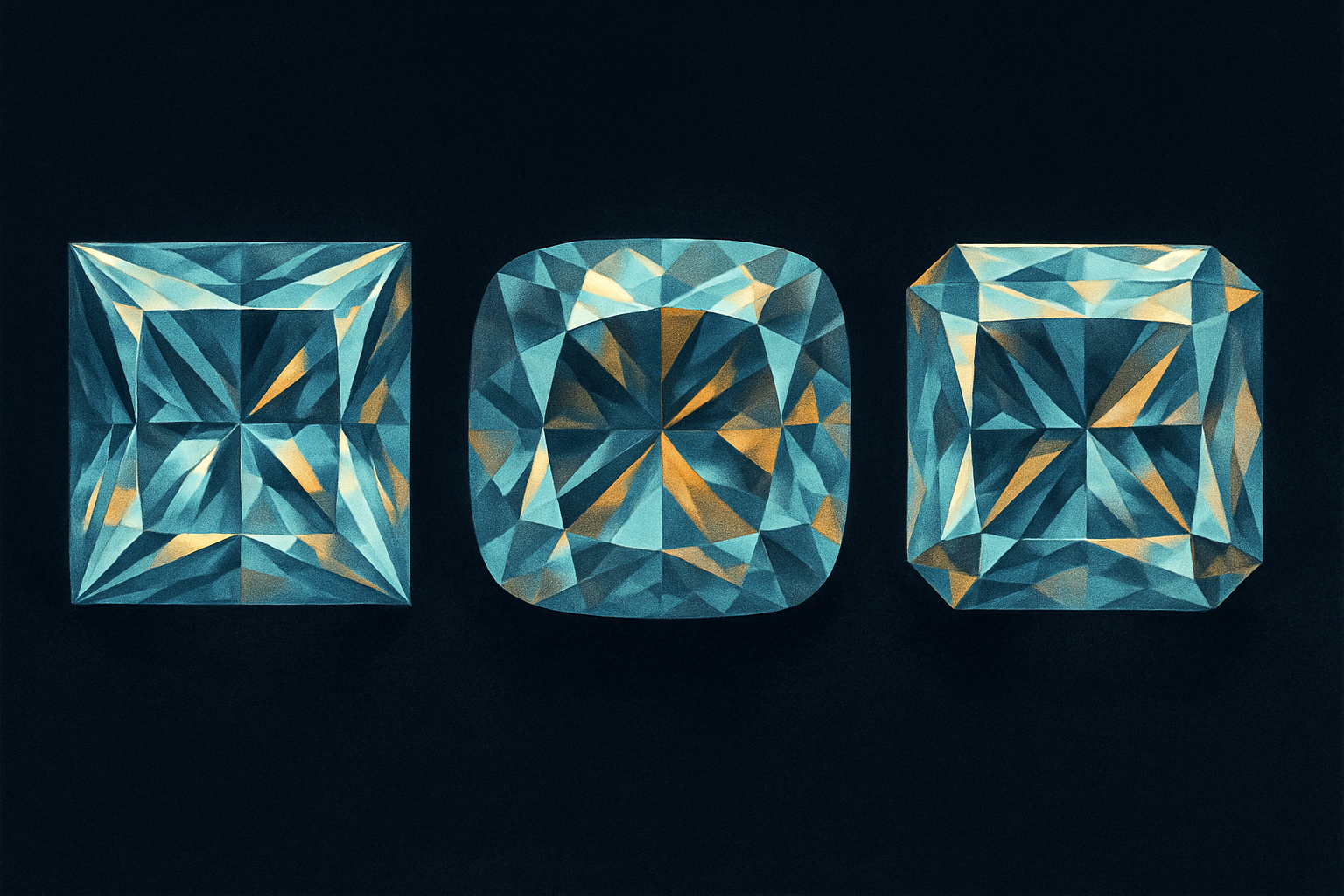
Left: princess cut with sharp corners and brilliant facets. Middle: cushion cut with softly rounded corners. Right: radiant cut with cropped corners and brilliant facet pattern.
The square-family segment
Princess, cushion, and radiant share a segment in the fancy-shape market that buyers cross-shop because the three shapes offer different solutions to the same broad aesthetic preference. The buyer who wants a square or near-square outline with sparkle and contemporary feel typically considers all three and chooses based on corner treatment, vintage-or-modern aesthetic preference, and the elongation flexibility that radiant offers.
Princess emerged as a distinct shape in the 1970s and 1980s and became one of the dominant alternatives to round brilliant in the engagement-ring market by the 1990s. Its sharp corners and brilliant facets produce a contemporary, clean-edged look that suits modern ring designs. Cushion is older as a cut family (originating in the 1700s as the 'old mine cut') and was redeveloped through the twentieth century into modern cushion-brilliant and 'crushed ice' patterns; it carries a vintage and softer aesthetic. Radiant was patented in 1977 by Henry Grossbard and was designed specifically to combine the sparkle of brilliant cuts with the elongation and corner-cropping of emerald cuts5.
All three are widely available in lab-grown and natural in 2026. The lab-grown share within each shape has grown through 2022 to 2025 in mainstream United States retail, broadly tracking the lab-grown share gain across fancy shapes more generally. JCK and other trade-press reporting consistently puts the square-family combined share in a meaningful minority position behind round brilliant and oval4.
| Shape | Corner treatment | Facet style | Aesthetic |
|---|---|---|---|
| Princess | Sharp 90-degree corners | Brilliant, modified cross-pattern | Contemporary, clean-edged |
| Cushion | Softly rounded corners | Brilliant or 'crushed ice' modified | Vintage, softer, romantic |
| Radiant | Cropped (chamfered) corners | Brilliant with elongated proportions | Hybrid sparkle-and-elongation |
Shape descriptions from GIA fancy-shape guidance1 and Grossbard patent reference5.
Princess: sharp corners and contemporary edge
Princess is the most rectilinear of the three. The corners are sharp ninety-degree angles, the outline is a true square (or slight rectangle), and the brilliant facet pattern produces strong sparkle with a particular cross-pattern reflection when viewed from above. A well-cut princess presents with high light return and a contemporary clean-edged look that suits modern engagement-ring designs.
The durability concern with princess is the sharp corners. Diamond is hard but is also brittle, and a sharp corner under impact can chip. A princess set with the corners exposed in a basic prong setting is vulnerable to chipping during ordinary wear; the standard solution is to use V-prong or chevron-prong settings that cover and protect the corners. A buyer choosing princess should specify a setting that protects the corners.
For lab-grown princess, the durability behaviour is identical to natural princess. The corner-chipping risk is a function of the diamond crystal's geometry and external impact, not its origin. Both categories require corner-protecting settings for active wear. Lab-grown princess inventory is widely available across all common grade tiers and weight bands.
Princess cut grade reporting is less detailed than round brilliant. GIA and IGI report a single descriptor (Excellent / Very Good / Good or equivalent) without proportions breakdown. The buyer's visual assessment focuses on facet symmetry, the depth of light return, the absence of obvious dead spots, and the corner cleanness. A poorly cut princess reads flat under inspection; a well-cut princess reads bright and lively.
Cushion: soft corners and vintage warmth
Cushion's defining feature is the softly rounded corners that distinguish it from princess. The outline can be true square or slightly rectangular (typically up to a 1.20:1 length-to-width ratio for a 'rectangular cushion'). The facet patterns vary widely: a 'standard cushion brilliant' has the same general facet structure as round brilliant adapted to the cushion outline, while a 'crushed ice' modified cushion has a denser pattern of smaller facets that produce a distinctive shimmery, glittery surface rather than the bigger flashes of light from brilliant facets.
The aesthetic of cushion leans vintage, soft, and romantic. The rounded corners and the variation in facet patterns give cushion stones a less mechanical, more organic feel than princess. Buyers who prefer the antique-jewellery aesthetic or the softer ring profile often choose cushion. The corner durability is good because the rounded corners do not concentrate stress at sharp points.
Lab-grown cushion inventory in 2026 covers both the standard brilliant pattern and the crushed ice modified pattern across the common grade and weight bands. The pattern choice is purely aesthetic and the price differential between the two patterns is small. The lab-grown share in cushion has grown in line with the broader fancy-shape lab-grown share gain.
Radiant: sparkle and elongation hybrid
Radiant was patented by Henry Grossbard in 1977 specifically to address the gap between emerald-cut elongation (with cropped corners and step-cut clarity demands) and brilliant-cut sparkle (with the bright light return that emerald cuts cannot match)5. The cropped corners give the stone a square-or-rectangular outline with the corners chamfered at roughly forty-five degrees; the brilliant facet pattern produces sparkle comparable to round brilliant.
Radiant outlines vary from true square (1.00:1 to 1.05:1) to elongated rectangular (1.20:1 to 1.50:1). The square radiant competes most directly with princess and cushion; the elongated radiant competes more with emerald cut, oval, and other elongated shapes. The buyer's preference between square and elongated radiant is purely aesthetic.
Durability on radiant is good because the cropped corners do not concentrate stress at sharp points. The stone is suitable for everyday wear without special setting protections, though prong-set radiant stones are often set in standard or V-prong configurations depending on the designer's preference.
Lab-grown radiant inventory is plentiful and the production economics favour radiant slightly over princess and cushion because the cropped-corner geometry uses more of the rough crystal efficiently. Lab-grown radiant pricing in 2026 sits at the same Bain category ratios as the other square-family shapes.
Cut grading and certification across the three
Cut grade reporting on all three shapes is less detailed than on round brilliant. GIA and IGI typically report a single cut descriptor without the proportions breakdown that round brilliant receives. The buyer's visual assessment matters more on these fancy shapes than on round brilliant, and counter-comparison testing under jeweller's lighting is the standard practice.
For lab-grown stones in any of the three shapes, IGI is the most common certification choice in 2026. GIA Premium-tier reports on these shapes are credible but less common than on round brilliant. GCAL 8X reports are available for these shapes and provide some additional light-performance data that the GIA standard report does not, which can be useful for cut-quality assessment. The full per-laboratory comparison is in the Certifications reference.
For natural stones, GIA is the standard. The GIA full Grading Report on princess, cushion, or radiant includes the 4Cs, measurements, and a clarity plot for stones above the Dossier threshold. The cut-grade descriptor is reported but is less analytically detailed than on round brilliant.
Choosing among the three
The decision among princess, cushion, and radiant is essentially aesthetic. Buyers who prefer sharp corners, contemporary feel, and clean rectilinear outlines lean toward princess and accept the corner-protection requirement in the setting. Buyers who prefer soft corners, vintage warmth, and a less mechanical aesthetic lean toward cushion. Buyers who want sparkle with elongation flexibility lean toward radiant.
For each shape, the lab-grown-versus-natural decision is the same as on round brilliant: the lab-grown option delivers the same visible material at roughly thirty per cent of the natural retail price with somewhat lower resale recovery, and the natural option carries the rarity narrative and the somewhat higher resale recovery. The choice of category does not interact strongly with the choice of shape; the buyer can decide each independently.
Cross-shopping the three shapes at the same lab-grown-versus-natural budget is straightforward because the Bain category ratios apply broadly across shapes. A buyer comparing three lab-grown stones (one of each shape) at the same grade and weight is comparing primarily on aesthetics; the price differences across the three lab-grown shapes are small. The same comparison in natural is also primarily aesthetic at the same grade-and-weight specification.
Cross-references
For the dominant round-brilliant shape, see the round brilliant guide. For oval, the fastest-growing fancy shape, see the oval guide. For step-cut shapes that share the cropped-corner family with radiant, see the emerald and asscher guide. For the pear, marquise, and heart fancies, see the fancies guide. For the 4Cs framework, see Chapter 3.
Frequently asked
What is the difference between princess, cushion, and radiant cuts?
Which of the three is best for an engagement ring?
Are princess diamonds going out of fashion?
Is the lab-grown discount the same on these as on round brilliant?
Does cut grade matter on these fancy squares?
Sources for this chapter
- GIA: Fancy Shape Diamond Grading, princess and cushion guidance - last verified May 2026
- Bain & Company: A Brilliant Recovery Shapes Up: The Global Diamond Industry 2021-22 (11th annual report) - last verified May 2026
- IGI: Laboratory Grown Diamond Reports including fancy shapes - last verified May 2026
- JCK: Trade reporting on fancy-shape demand shifts - last verified May 2026
- Henry Grossbard: Original Radiant Cut patent (1977) historical reference - last verified May 2026
- Rapaport: Fancy-shape pricing in the polished price list - last verified May 2026