Oval Lab-Grown vs Natural Diamond
Oval has been the fastest-growing engagement-ring shape demand between 2020 and 2026. The elongation gives the stone a visibly larger appearance per carat than round brilliant, the shape suits a range of finger types, and the celebrity-engagement-ring driver through the late 2010s pulled the shape into mainstream awareness. This page walks through the oval comparison on cut quality (with the bowtie effect as the key non-certified variable), elongation ratios, certification limits on fancy shapes, and the lab-grown availability picture across grade bands.
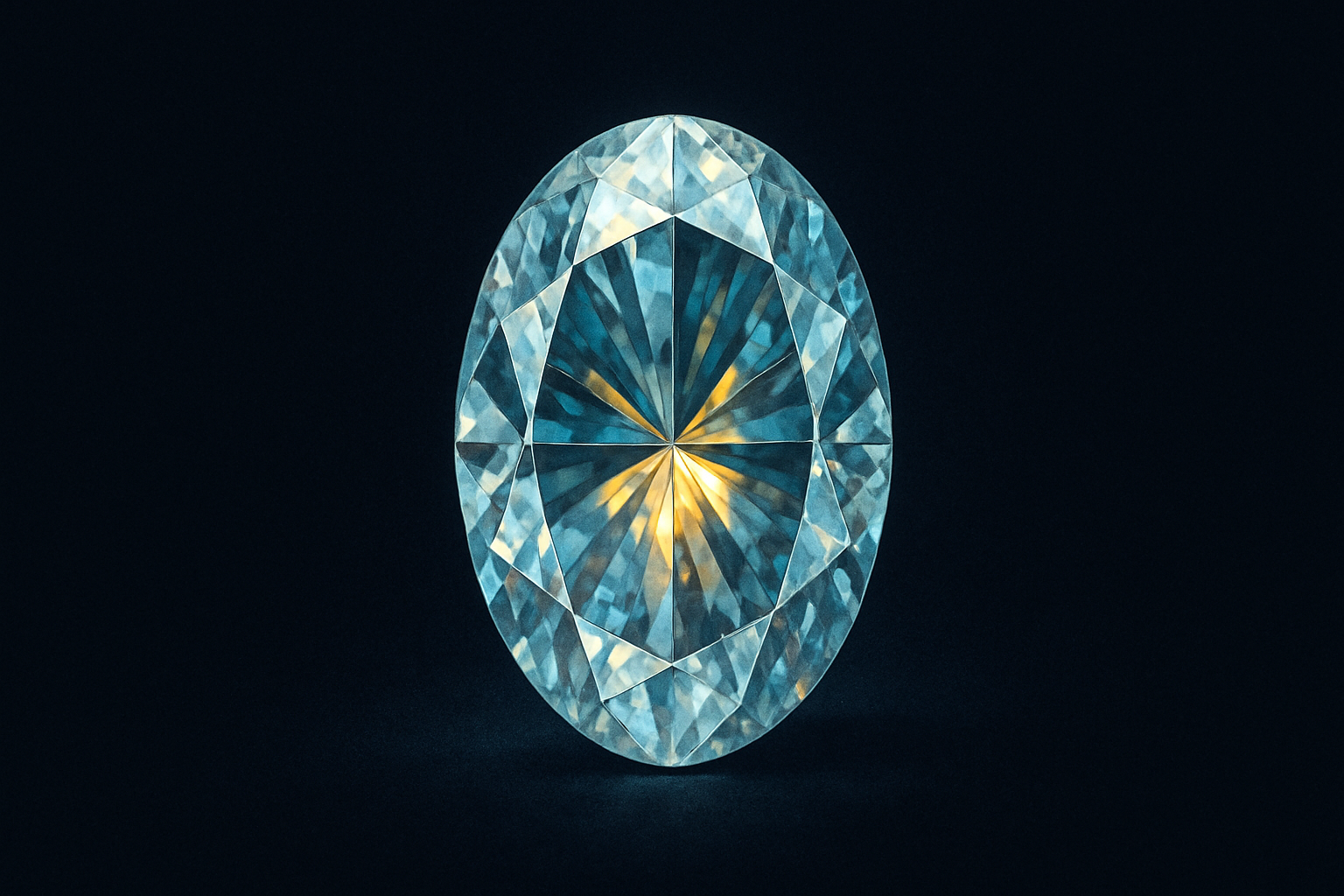
Oval brilliant cut. The brilliant facet pattern is broadly the same as round brilliant but applied to an elongated outline, with the elongation ratio (length to width) being a primary aesthetic variable.
The oval ascendancy
Oval was the fastest-growing engagement-ring shape between 2020 and 2026 in mainstream United States retail data. JCK and National Jeweler trade-press reporting through the period repeatedly identified oval as taking share from round brilliant at the engagement-ring centre-stone tier, particularly in the one-to-two-carat weight band45. The shape did not displace round brilliant as the modal shape but narrowed the gap meaningfully.
Three reinforcing drivers explain the shift. First, visible-size economics: an oval reads as a larger stone on the hand at the same carat weight because the elongated proportions distribute the carat mass over a longer top surface than round brilliant. A one-and-a-half-carat oval may visually rival a two-carat round brilliant on most fingers. Second, ring-design fit: oval elongates the finger visually and accommodates halo and three-stone settings without the visual heaviness that some round-brilliant settings produce. Third, celebrity-engagement-ring visibility: several high-profile engagement-ring announcements through the late 2010s prominently featured oval centre stones, which seeded consumer awareness and influenced retail demand.
For lab-grown stones, the oval ascendancy has been particularly pronounced. Lab-grown production is well-suited to producing rough crystals shaped for fancy-cut work, and oval lab-grown stones at all common weight bands are widely available at competitive prices. The lab-grown oval segment grew substantially through 2022 to 2025 and now represents a meaningful share of total oval engagement-ring purchases in mainstream US channels.
Length-to-width range from GIA and trade-press reporting24; lab-grown-to-natural retail ratio from Bain reporting1.
The bowtie problem
The single most important non-certified cut-quality variable on oval is the bowtie. A bowtie is a dark area across the centre of an oval stone, visible from above, that resembles a bowtie or hourglass shape across the width of the stone. It is caused by light leakage out of the pavilion in the centre of the stone, where the elongated geometry prevents the pavilion facets from returning light to the viewer's eye as efficiently as they do near the ends of the stone.
Every oval has some bowtie. The question is whether the bowtie is faint, moderate, or prominent. A faint bowtie is barely visible under normal lighting and does not affect the stone's overall presentation. A moderate bowtie is visible under inspection but does not dominate the stone's appearance under most viewing conditions. A prominent bowtie is visible from across the room and meaningfully reduces the stone's perceived brilliance and presence. The assessment is visual rather than instrumental.
GIA and IGI do not grade or report bowtie severity on their oval reports. The buyer must assess it directly by inspecting the stone (or a high-resolution image) under multiple lighting conditions. Reputable online retailers provide rotating videos that allow bowtie assessment remotely; in-person inspection at a counter remains the best method. The bowtie can be the difference between an oval that presents beautifully and one that disappoints, and a buyer paying any meaningful sum should make the assessment a priority before committing.
For lab-grown ovals, the bowtie behaviour is identical to natural ovals at the same proportions. The cutting labour and standards apply equally; a well-cut lab-grown oval has a faint bowtie and a poorly-cut lab-grown oval has a prominent one, on the same terms as natural. The category does not affect the bowtie outcome.
Length-to-width ratios
The elongation ratio (length divided by width) is the most-shopped oval variable after the bowtie. The most-preferred ratio range is roughly 1.35:1 to 1.50:1, with values around 1.40:1 to 1.45:1 being modal in mainstream retail inventory. Below 1.35:1 the stone reads more rounded and loses some of the elongation advantage; above 1.50:1 the stone reads narrower and may appear pinched or stretched in some settings.
The ratio is reported on most laboratory grading reports and is used for cross-shopping. A buyer selecting an oval typically shortlists by ratio within a preferred range, then evaluates the shortlisted stones on bowtie, cut quality, and the standard 4Cs grades. The ratio is not the only variable but is a useful initial filter.
For lab-grown ovals, the ratio distribution in available inventory matches the natural distribution. Lab-grown producers can target specific ratios in production but typically produce a range of ratios to match retail demand. Cross-shopping by ratio works identically across categories.
Cut grade and certification on oval
Cut grade reporting on oval is less detailed than on round brilliant. GIA and IGI typically report a single descriptor for oval cut (Excellent / Very Good / Good or equivalent) without the proportions breakdown that round brilliant receives. The descriptor reflects the laboratory's overall assessment of the stone's symmetry, polish, and proportions, but does not capture the bowtie or the elongation ratio directly, both of which are reported separately.
The implication is that the buyer's own visual assessment matters more on oval than on round brilliant. A high-grade cut descriptor on the report is necessary but not sufficient; the bowtie and ratio must be confirmed independently. A counter-comparison test where the buyer puts two or three ovals side by side under jeweller's lighting is the standard practice.
For certification choice on oval, IGI is the most common laboratory for lab-grown ovals, GIA is the most common for natural ovals, and GCAL is a credible third option for buyers who want the light-performance metrics that GCAL reports. The GCAL 8X format for oval includes some of the light-performance metrics that the GIA standard report does not, which can be useful for cut-quality assessment. The full per-laboratory comparison is in the Certifications reference.
Grade selection on oval
The most-shopped grade tier on oval is roughly the same G to H colour, VS1 to VS2 clarity tier that dominates round brilliant. The visible-size advantage of oval over round brilliant at the same weight does not extend to colour or clarity reading; colour and clarity present similarly across the two shapes. A buyer accustomed to evaluating colour and clarity on round brilliant transfers the same calibration to oval without difficulty.
One specific colour-related consideration on oval: the elongated shape can sometimes show colour casting more visibly than round brilliant in lower colour grades (I, J, K), because the longer light path through the stone amplifies any inherent yellow tint. A buyer considering a J-colour oval may find it reads warmer than a J-colour round brilliant of the same weight; the colour-grade premium for going to G or H is therefore slightly more justifiable on oval than on round brilliant.
For lab-grown ovals, the same colour and clarity considerations apply. Lab-grown production at the top of the colour and clarity scales is plentiful and the cost premium for pushing grade tiers is small, so most lab-grown oval inventory in mainstream retail sits at G or above and at VS2 or above.
Setting and wearing oval
Oval suits a range of settings well. Solitaire settings showcase the elongated shape cleanly; halo settings add visible diameter and integrate well with the oval outline; three-stone settings can flank an oval centre with smaller ovals or with trillions. The setting choice depends on the wearer's aesthetic and the overall ring scale rather than on the lab-grown-versus-natural category.
On the wearer's hand, oval elongates the finger visually and is sometimes recommended for shorter fingers or for wearers who prefer a slimming visual effect. The east-west orientation (long axis perpendicular to the finger) is occasionally chosen as a distinctive variant of the standard north-south orientation; the choice is aesthetic and does not affect the stone's optical performance.
For lab-grown ovals, the setting and wearing considerations are identical. The setter does not care about the stone's origin and the wearer cannot tell the category from the visible appearance. The decision on category is contained in the centre-stone selection itself.
Cross-references
For the dominant round-brilliant comparison, see the round brilliant guide. For other fancy shapes: princess/cushion/radiant, emerald and asscher, pear/marquise/heart. For per-carat considerations on oval, the per-carat guides apply with the visible-size advantage noted above. For the 4Cs framework, see Chapter 3.
Frequently asked
Why has oval become so popular?
What is the bowtie effect?
What length-to-width ratio is best for oval?
Is the lab-grown oval discount similar to round brilliant?
Does cut grade matter as much on oval as on round brilliant?
Sources for this chapter
- Bain & Company: A Brilliant Recovery Shapes Up: The Global Diamond Industry 2021-22 (11th annual report) - last verified May 2026
- GIA: Fancy Shape Diamond Grading and Oval Brilliant - last verified May 2026
- IGI: Laboratory Grown Diamond Reports including fancy shapes - last verified May 2026
- JCK: Trade reporting on oval and fancy-shape demand shifts - last verified May 2026
- National Jeweler: Engagement-ring shape trend reporting - last verified May 2026
- Paul Zimnisky: Lab-grown fancy-shape production commentary - last verified May 2026