Emerald and Asscher Lab-Grown vs Natural Diamond
Step cuts are the architectural alternative to brilliants. Emerald (rectangular) and asscher (square) share a step-facet structure that produces a 'hall of mirrors' light play and reveals inclusions much more clearly than brilliant facets do. The clarity-grade demand is higher than on brilliants and the cut quality is judged more on facet symmetry and depth than on light return. This page walks through the step-cut comparison on clarity selection, cut quality, lab-grown availability, and the Art Deco aesthetic the shapes carry.
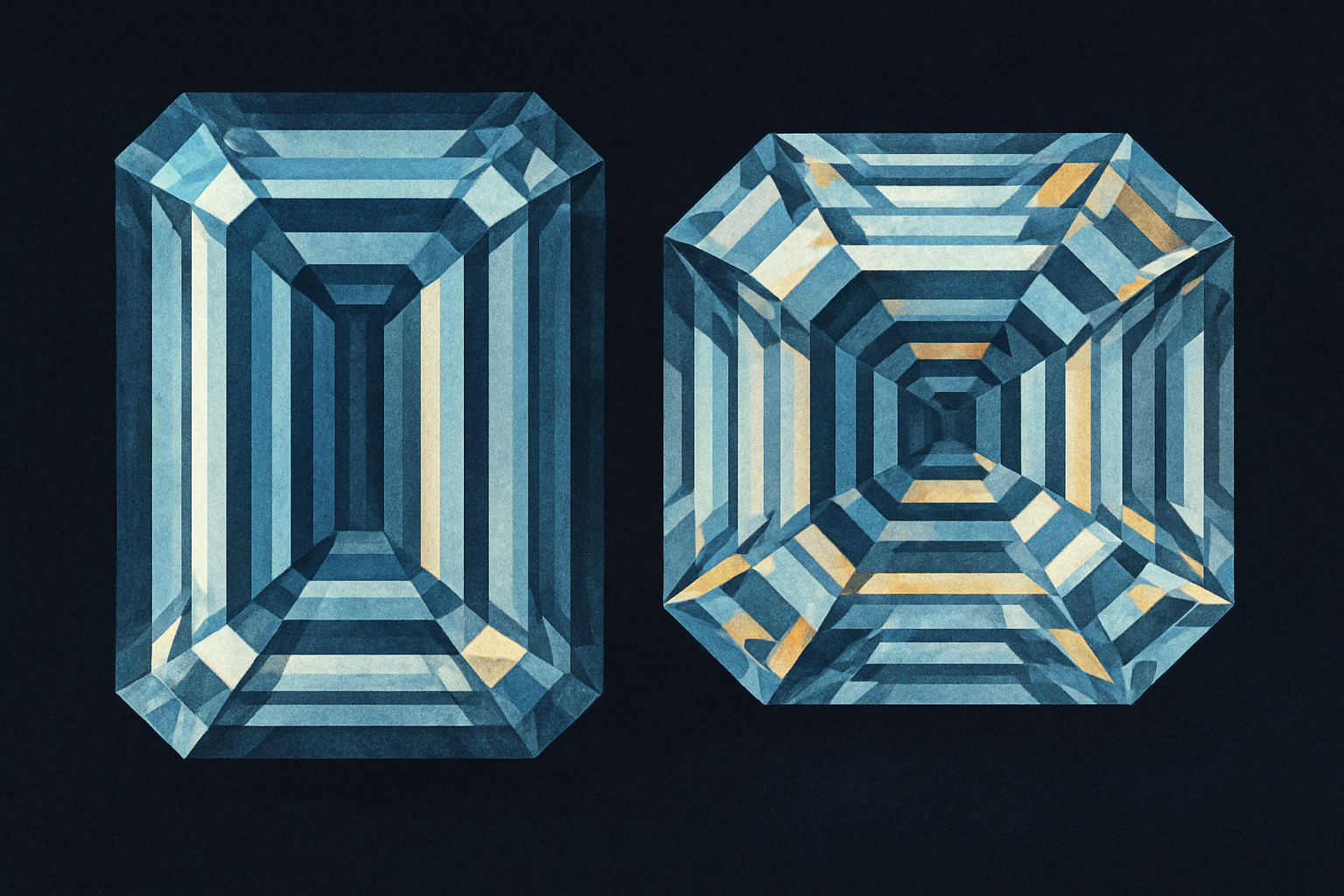
Left: emerald cut (rectangular with step facets and cropped corners). Right: asscher cut (square with step facets and cropped corners). The parallel step facets produce the characteristic 'hall of mirrors' light reflections.
Step cuts are a different aesthetic register
Step cuts (the family that includes emerald and asscher) are visually distinct from brilliant cuts in a fundamental way. The facet structure consists of broad, parallel, rectangular facets arranged in steps descending from the table to the culet, like the steps of a pyramid viewed in cross-section. The pattern produces flashes of broad light reflection rather than the small twinkling sparkles of brilliant cuts, and viewing the stone from above shows the characteristic 'hall of mirrors' effect where the parallel facets reflect into each other to create a layered visual depth1.
The aesthetic is sophisticated, restrained, and Art-Deco-adjacent. The shapes carry historical associations with the 1920s and 1930s jewellery design movements, which is one of the reasons engagement-ring buyers who specifically want a vintage or architectural feel often gravitate to step cuts. The buyer who wants conventional round-brilliant sparkle does not typically end up with an emerald or asscher; the buyer who wants something distinctive and architectural often does.
For lab-grown stones, the step-cut aesthetic is identical. The cutting standards are the same, the proportions are the same, and the visible appearance at the wearer's hand is the same as natural. The category does not affect the visual register of the shape; it affects the price and the resale and certification considerations.
| Shape | Outline | L:W ratio | Clarity floor |
|---|---|---|---|
| Emerald | Rectangular with cropped corners | 1.30:1 to 1.60:1 | VS1 recommended, VVS2 preferred |
| Asscher | Square with cropped corners | 1.00:1 to 1.05:1 | VS1 recommended, VVS2 preferred |
Outline and ratio guidance from GIA fancy-shape grading methodology1. Clarity-floor recommendations from trade-press buying guides4.
The clarity-grade requirement
The single most important fact about buying step cuts is that the clarity-grade requirement is higher than for brilliants. A small inclusion that hides invisibly in the busy facet pattern of a round brilliant or princess cut may be plainly visible through the broad open facets of an emerald or asscher cut. The mainstream recommendation across trade-press buying guides is VS1 as the working floor on step cuts, with VVS2 preferred where budget allows4.
The reason is geometric. Brilliant facets are small and angled to reflect light multiple times before it returns to the eye, which produces visual 'noise' that masks small inclusions. Step facets are large and arranged to reflect light through a single reflection path, which produces visual 'clarity' and makes any imperfection more apparent. The same inclusion grade reads differently across the two facet structures.
The clarity-grade premium adds cost to step-cut purchases. A buyer comparing a VS1 emerald to a VS2 round brilliant at the same colour and weight will find the step cut more expensive at the same nominal price band, because the higher clarity grade carries a price premium. The premium is meaningful but is part of the cost structure of choosing step cuts at all; a buyer not willing to specify VS1 or above should reconsider the shape choice.
For lab-grown step cuts, the same clarity considerations apply. Lab-grown production at VS1 and above is plentiful and the cost premium for pushing to VVS2 is smaller than in natural, so lab-grown step-cut inventory in mainstream retail often sits at VVS2 or above as a baseline. The buyer's choice on lab-grown step cuts can routinely include VVS clarity without large budget impact.
Emerald cut specifics
Emerald cut is the rectangular member of the step-cut family. The cropped corners (typically chamfered at forty-five degrees) give the stone a clean octagonal outline when traced precisely. The length-to-width ratio range for emerald is roughly 1.30:1 to 1.60:1, with 1.40:1 to 1.50:1 being the most-shopped band. Below 1.30:1 the stone reads too square (and the buyer might prefer asscher); above 1.60:1 the stone reads narrow and architectural in a way that some buyers find too elongated.
The visual presentation of a well-cut emerald is the hall-of-mirrors light play, where the broad parallel step facets reflect into each other and produce a layered depth effect. Cut quality on emerald is judged largely on facet symmetry (the steps should be parallel and evenly spaced), depth (a too-shallow emerald loses the hall-of-mirrors depth, a too-deep emerald loses brightness), and overall geometric precision. A well-cut emerald has visual presence that competes with much larger brilliants for impact.
Lab-grown emerald inventory in 2026 covers the common ratio range and grade tiers. The cutting labour for emerald is similar to natural and the standards are the same. A buyer comparing lab-grown and natural emerald at the same VS1 colour-clarity-cut specification compares like-for-like with confidence.
Asscher cut specifics
Asscher cut is the square member of the step-cut family. The outline is essentially square with cropped corners, producing an octagonal outline when traced precisely. The length-to-width ratio is close to 1.00:1, with up to 1.05:1 being common; ratios above 1.10:1 are typically classified as rectangular and may be marketed as 'modified asscher' or 'square emerald' depending on the laboratory and retailer.
Joseph Asscher patented the original asscher cut in 1902 and the Royal Asscher family continued to refine the cut through the twentieth century with proprietary variants including a higher-facet-count modern version5. The classic asscher cut is the basis of the broader market; the proprietary Royal Asscher variants carry brand premiums and are less commonly cross-shopped.
The asscher aesthetic is the squarest possible step-cut presentation, with the strongest hall-of-mirrors effect because the corner-to-corner symmetry produces particularly clean parallel reflections. The shape carries a strong Art Deco association and is favoured by buyers who specifically want that aesthetic. Lab-grown asscher inventory is somewhat less plentiful than emerald inventory because production volumes are lower, but coverage at common grade and weight bands is adequate.
Cut grade and certification on step cuts
Cut grade reporting on emerald and asscher is the least detailed across the major shapes. GIA and IGI report a single cut descriptor (Excellent / Very Good / Good or equivalent) without proportions breakdown, and the descriptor is calibrated to step-cut specific quality criteria (facet symmetry, depth, polish, corner precision) rather than the brilliant-cut light-return framework.
The buyer's visual assessment matters most on step cuts. A counter-comparison test under varied lighting is the standard practice: a well-cut step cut shows clean parallel reflections and consistent hall-of-mirrors depth across the stone, while a poorly cut step cut shows uneven steps, dead spots near the corners, or visible facet asymmetry. The assessment is not technical but is reliable with practice.
For lab-grown step cuts, IGI is the most common certification choice. GIA Premium-tier reports on step cuts are credible but less common; the GIA grading apparatus is calibrated most fully for round brilliant and applies more loosely to step cuts. GCAL 8X reports on step cuts are also available and provide some additional measurement data. The full per-laboratory comparison is in the Certifications reference.
Choosing step cuts
The buyer who chooses emerald or asscher in 2026 is making a specific aesthetic statement. The shapes are sophisticated, architectural, and Art-Deco-adjacent in a way that distinguishes them from round brilliant and from the other fancy shapes. They are not the choice for a buyer who wants conventional sparkle; they are the choice for a buyer who wants a different visual register.
The lab-grown step-cut option in 2026 brings the higher clarity-grade requirement into reach of a wider band of budgets. A lab-grown VVS2 emerald at one or two carats is a much more accessible purchase than the natural equivalent, and the cost-saving from choosing lab-grown enables the buyer to specify the higher clarity grade that the shape genuinely benefits from. The case for lab-grown is particularly strong on step cuts for cost-conscious buyers who want the shape but not the natural clarity-premium cost.
For the buyer who wants a natural step cut, the choice between emerald and asscher is purely aesthetic (rectangular versus square) and the certification choice is essentially GIA. The selection process involves more visual inspection than for round brilliant, and the clarity-grade specification is the working starting point.
Cross-references
For the brilliant-faceted alternative with elongated proportions, see oval. For radiant cut, which combines brilliant facets with the cropped-corner outline of step cuts, see the princess/cushion/radiant guide. For the other fancy shapes, see the pear/marquise/heart guide. For the dominant round brilliant, see the round brilliant guide. For the 4Cs framework and the clarity scale, see Chapter 3.
Frequently asked
Why do step cuts need a higher clarity grade than brilliants?
What is the difference between emerald and asscher?
Do step cuts sparkle?
Is the lab-grown discount the same on step cuts?
Are emerald and asscher engagement rings unusual?
Sources for this chapter
- GIA: Step Cut Diamonds, Emerald and Asscher - last verified May 2026
- Bain & Company: A Brilliant Recovery Shapes Up: The Global Diamond Industry 2021-22 (11th annual report) - last verified May 2026
- IGI: Laboratory Grown Diamond Reports for step cuts - last verified May 2026
- JCK: Trade reporting on step-cut demand - last verified May 2026
- Joseph Asscher: Asscher cut historical reference, 1902 patent - last verified May 2026
- Rapaport: Step-cut pricing in the polished price list - last verified May 2026