1 Carat Lab-Grown vs Natural Diamond
One carat is the most-shopped centre-stone weight for engagement-ring purchases in the United States. It is the benchmark row in the Rapaport price list, the modal size in retailer assortments, and the weight at which the lab-grown discount becomes consequential in absolute dollar terms. This page walks through the one-carat comparison on grade, certification, and visible presentation across the two categories.
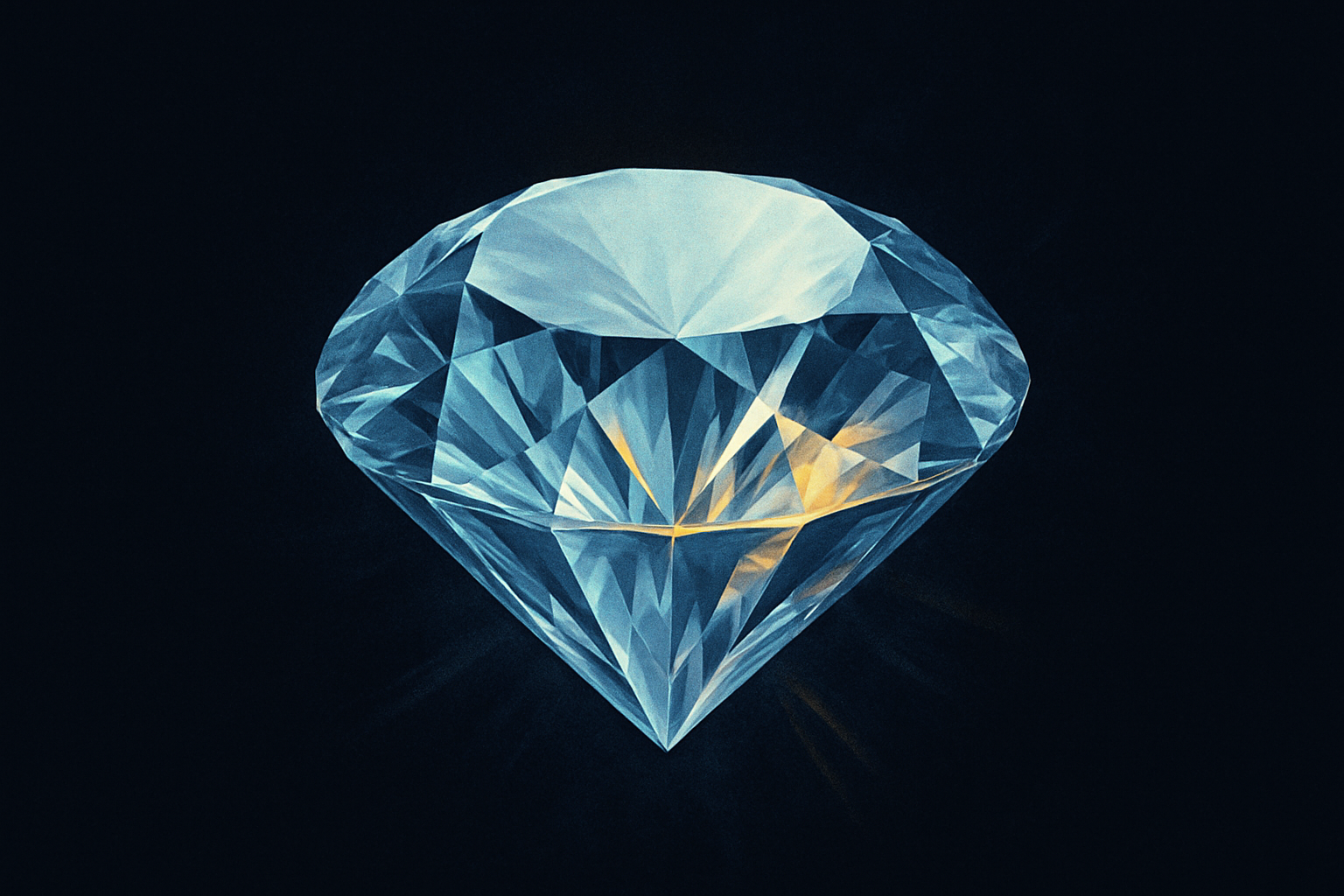
Round brilliant cut, the dominant shape for one-carat engagement-ring centre stones in both lab-grown and natural categories.
Why one carat dominates
One carat is the benchmark engagement-ring centre-stone weight in the United States and in most large mainstream markets globally. The reasons are historical and self-reinforcing rather than purely physical. Retailer assortments are densest in the 0.9 to 1.2 carat band, the Rapaport price list calibrates its grid around the one-carat row, and trade-press reporting from JCK and National Jeweler consistently identifies one carat as the modal centre-stone size in the United States56.
The physical case is straightforward. A one-carat round brilliant at standard cutting proportions measures roughly six-point-four millimetres at the table, which reads as a clearly substantial centre stone in a solitaire, halo, or three-stone setting. The visible scale is meaningful enough to be unambiguously the focal element of a ring without being so large that it dominates the wearer's hand at typical proportions. The size is in the comfort zone for most settings, metals, and ring styles.
For lab-grown stones, one carat has emerged as the dominant entry size in retail assortments built around the lab-grown discount. The same physical proportions apply, the same setting suite works, and the price point at lab-grown allows a one-carat stone to fit budgets that would otherwise have to consider a half-carat or three-quarter-carat natural alternative. The category mix in the one-carat band shifted toward lab-grown most rapidly between 2020 and 2024.
Ratios from Bain Global Diamond Industry Report (2021-22)1. Wholesale data shifts month to month and the ratio at any given moment may sit either side of the average.
Wholesale and retail at the one-carat band
The wholesale price gap at the one-carat band tracks the broader Bain ratios closely. Polished one-carat lab-grown stones at IGI grades equivalent to GIA G VS1 trade at roughly fourteen per cent of natural one-carat polished wholesale, with month-to-month dispersion of several percentage points either side1. The Zimnisky lab-grown wholesale index has shown continued downward movement through 2025 and into early 2026, suggesting that the ratio at the wholesale level is closer to thirteen per cent than fifteen per cent in mid-2026 reporting4.
On the retail side, the absorption of wholesale compression by retailer markups produces a higher ratio. Lab-grown polished retail at one carat sits closer to thirty per cent of natural retail in mainstream US channels, with substantial dispersion across retailers and across stones. The retail gap is therefore meaningfully narrower than the wholesale gap; the retailer keeps a larger share of the lab-grown wholesale discount than the customer does.
Both ratios shift with stone grade. A one-carat D-flawless stone has a different lab-grown-to-natural ratio than a one-carat G-VS1 stone, because the rarity premium for top grades is larger in natural than the corresponding grade premium in lab-grown. The mainstream G-H VS1-VS2 band, which dominates engagement-ring sales, sits close to the Bain category averages quoted above.
Grade selection at one carat
The most-shopped grade tier at one carat is roughly G to H colour, VS1 to VS2 clarity, Excellent or Very Good cut on round brilliants. This tier produces stones that are eye-clean to the unaided eye under normal lighting, near-colourless against white-metal settings, and bright in light return at well-proportioned cut grades. The grade band is the same in lab-grown and natural categories; the price ratio applies within the tier.
The argument for pushing above this tier is partly aesthetic and partly resale. A buyer who values the highest grade band for personal reasons or who anticipates resale considerations may pay the premium for E or F colour and for VVS or IF clarity. The grade-tier price premium is substantial in natural stones and noticeable in lab-grown stones, though the absolute dollar premium in lab-grown is much smaller because the base price is lower.
The argument for staying below the most-shopped tier (I-J colour, SI1-SI2 clarity) is largely budget. A one-carat I VS2 in a yellow-gold setting can present cleanly and the cost saving is meaningful. A one-carat J SI1 begins to be visibly off-colour in white-metal settings and may show inclusions under inspection; whether this matters depends on the buyer and the setting. The 4Cs framework that explains the grade scales is in Chapter 3.
Cut grade is the highest-impact specification
At one carat the single specification most directly tied to visible quality is cut grade. A one-carat round brilliant at GIA Excellent or AGS Ideal-0 (legacy) measures close to six-point-four millimetres at the table and exhibits strong light return, fire (spectral dispersion), and scintillation. A one-carat round brilliant at Good cut may measure closer to six-point-one millimetres at the table and exhibit visibly less brilliance, despite weighing the same on the certificate.
The cost premium for Excellent over Very Good is modest in both lab-grown and natural categories. The buyer who specifies Excellent cut at one carat generally captures the visible-quality gain without much budget movement. Pushing to 'Hearts and Arrows' or to AGS Ideal-0 (where still available on legacy stones) adds further cost for a marginal optical-symmetry gain that some buyers value and some do not.
For round brilliants specifically, cut grade is reported by both GIA and IGI. For fancy shapes, cut grade is typically reported informally (Excellent / Very Good / Good without further breakdown) or not reported at all, and the assessment of cut quality is left to the buyer's inspection. The shape-by-shape considerations are in the shape guides linked at the bottom of this page.
Certification at one carat
For a natural one-carat stone, the GIA full Grading Report (with hand-drawn or rendered clarity plot) is the standard. The Dossier format is acceptable but the full Grading Report is the typical choice from one carat upward because the marginal report cost is small and the plot adds value for resale documentation and for the buyer's confidence in the clarity grade. Stones offered without GIA at this size are sold at a discount that reflects the reduced liquidity.
For a lab-grown one-carat stone, an IGI report is the most common and is the easiest to cross-shop. A 2026 IGI lab-grown report uses the same 4Cs format that is familiar from natural reports and from earlier-vintage GIA lab-grown reports. A GIA Premium-tier report is credible but harder to compare against IGI inventory; a buyer cross-shopping multiple lab-grown stones across retailers will find the IGI format more practical.
A GCAL 8X report on a one-carat stone adds quantitative light-performance metrics that some buyers find useful for cut-quality comparisons. GCAL grades natural and lab-grown stones on the same 4Cs scale and is a reasonable choice for a buyer who prioritises cut over the lab-grown-versus-natural certification calibration. The full comparison is in the Certifications reference.
The one-carat decision frame
The decision frame for a one-carat engagement-ring stone in 2026 is essentially a budget-and-values call. The lab-grown option delivers a one-carat well-cut Excellent stone for a price that fits a much wider band of budgets than the equivalent natural stone, and the visible quality at the wearer's hand is identical. The natural option carries the rarity narrative, a slightly better resale recovery (twenty to fifty per cent of paid retail versus ten to thirty per cent for lab-grown, per Chapter 14), and the historical engagement-ring narrative.
There is no universal right answer because the trade-off depends on the buyer's values. A buyer who treats the purchase as a consumption decision and prioritises the present-moment value of the size and quality leans toward lab-grown. A buyer who places weight on the long-run resale recovery, the heritage element, or the rarity narrative leans toward natural. The decision is more individual than the price comparison suggests.
The decision-frame analysis specifically for engagement-ring purchases is in the engagement-ring guide. The ethical and sourcing considerations that some buyers weigh alongside price are in Chapter 12 and Chapter 11.
Cross-references
For the smaller half-carat comparison, see the half-carat guide. For the next step up, see the two-carat guide. For the structural production economics that explain the wholesale gap, see Chapter 7. For the market data on share gain and wholesale movement, see Chapter 9. For the certification choice in detail, see the Certifications reference. For the full price-by-carat overview, see the price-by-carat hub.
Frequently asked
Why is one carat the benchmark engagement-ring size?
How much can I save by choosing lab-grown at 1 carat?
Will a 1 carat lab-grown look smaller than a 1 carat natural?
Is GIA certification worth the extra cost at 1 carat?
What about cut grade and clarity at this size?
Sources for this chapter
- Bain & Company: A Brilliant Recovery Shapes Up: The Global Diamond Industry 2021-22 (11th annual report) - last verified May 2026
- GIA: 4Cs of Diamond Quality, full Grading Report - last verified May 2026
- IGI: Laboratory Grown Diamond Reports - last verified May 2026
- Paul Zimnisky: Global Rough Diamond Price Index and lab-grown commentary - last verified May 2026
- Rapaport: RAPI index and trade pricing commentary - last verified May 2026
- JCK: Engagement-ring stone-size trade reporting - last verified May 2026