0.5 Carat Lab-Grown vs Natural Diamond
Half-carat round brilliants are the entry-size centre stone for mainstream engagement rings. At this weight the absolute wholesale dollar gap between lab-grown and natural is smallest, the cut-grade contribution to visual presence is largest, and the case for IGI versus GIA certification depends on whether the buyer is cross-shopping across categories. This page walks through the half-carat comparison on a per-grade basis using Bain wholesale ratios and trade-press reporting.
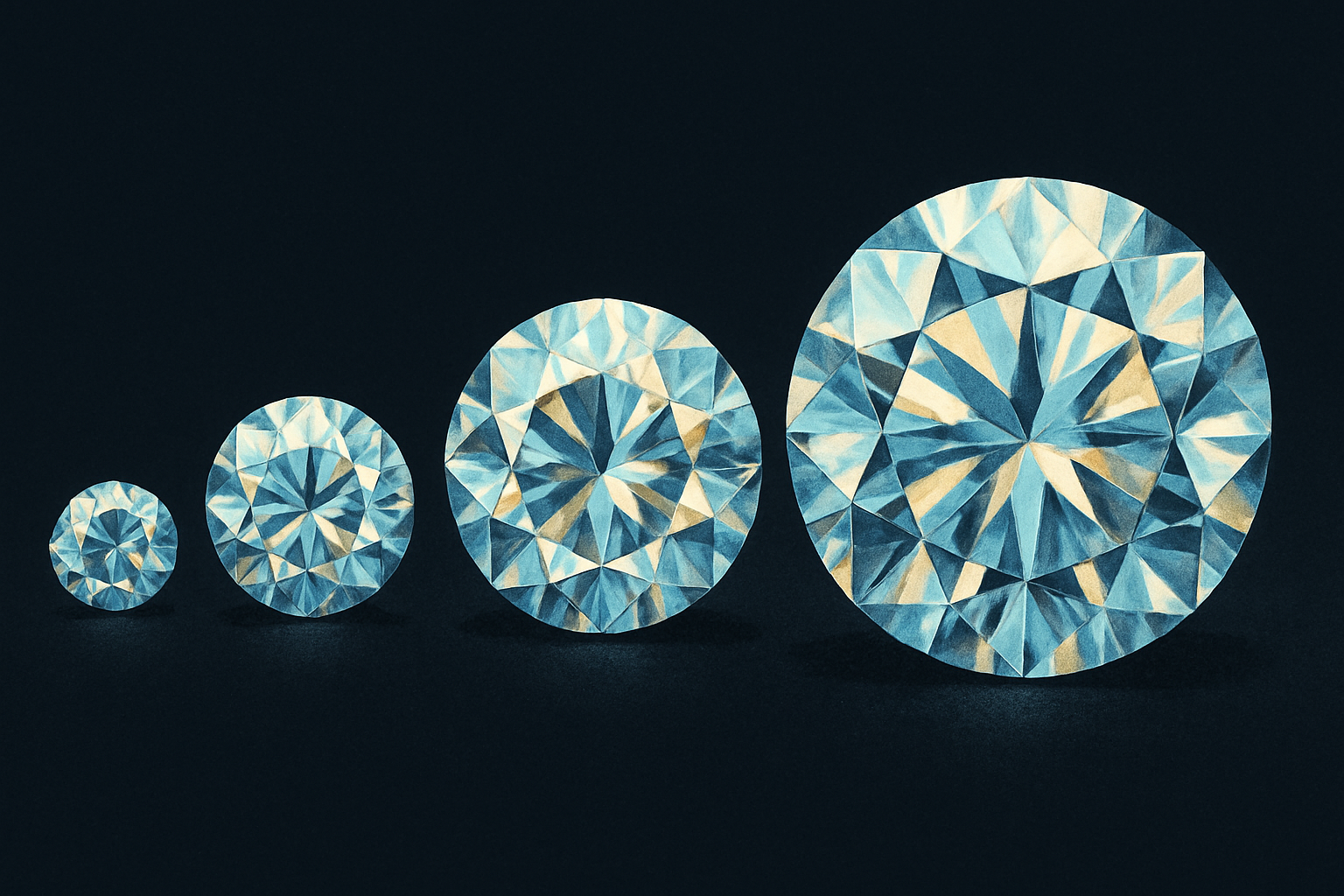
A scale comparison of round brilliant diamonds at graduated carat weights. Half-carat sits at the small end of this range, with one-carat, two-carat, three-carat, and five-carat stones each represented further along.
Why half-carat is the entry weight
A half-carat round brilliant diamond, well cut, sits at roughly five millimetres of visible diameter at the table. That is large enough to read as a meaningful centre stone in any typical engagement-ring setting (solitaire, halo, or three-stone) and small enough to fit a tighter budget than the one-carat-and-up market. Industry retailer assortments treat half-carat as a standard centre-stone weight, and the Rapaport price list reports half-carat as its own row in the wholesale grid for both natural and lab-grown categories6.
The 'entry weight' framing is descriptive rather than dismissive. A meaningful share of engagement-ring purchases in the United States are at half-carat or smaller, and the visual presence of a well-cut half-carat in a halo setting is comparable to that of a one-carat solitaire in pure surface terms. The choice of carat weight is in part a budget call and in part a personal-preference call about visual scale.
At this size the lab-grown versus natural comparison takes on a particular shape. The wholesale dollar gap is smallest in absolute terms, the wholesale percentage gap matches the broader market, and the cut-grade contribution to perceived size is at its largest. The half-carat comparison is therefore the one where the maths of the lab-grown discount feels least dramatic at the counter, even though the structural ratio is the same.
Wholesale and retail ratios from Bain Global Diamond Industry Report (2021-22)1. Ratios are category averages; individual stones may sit either side.
Grade conventions at half-carat
The most-shopped grade tier for half-carat engagement-ring diamonds runs roughly G to H in colour and VS1 to VS2 in clarity, with Excellent or Very Good cut on round brilliants. This grade band balances visual clarity (eye-clean to the unaided eye), near-colourless appearance against most metal settings, and price moderation. The same grade band applies in both lab-grown and natural markets; the price differential is the differential noted above.
Below G colour, the warmth begins to read against white-metal settings (white gold, platinum) at a half-carat stone's size. Above H, the price premium for marginal colour gain is large relative to visual benefit at this carat weight. The clarity band has similar logic: VS1 and VS2 stones are eye-clean to nearly all observers under normal lighting, while VVS premiums add meaningful cost for a distinction that is not visible to the unaided eye on most stones.
For lab-grown half-carat stones graded by IGI in 2025-2026, the same 4Cs scale applies and the most-shopped grade tier remains roughly G to H, VS1 to VS2. For GIA lab-grown half-carat stones graded after October 2025, the Premium tier maps loosely onto the upper portion of the traditional G/H VS1/VS2 band, and the Standard tier maps onto the broader middle of the lab-grown market. The mapping is imprecise because the GIA Premium / Standard system is not a direct translation. The grading-change chapter covers the detail.
Cut grade pays off more here
Cut grade has a particular importance at half-carat because the visible-diameter difference between a well-cut and a poorly-cut half-carat is meaningful in absolute millimetres. A round brilliant at exact half-carat weight with a steep crown angle and a deep pavilion may measure four-point-eight millimetres at the table, while a well-proportioned half-carat measures closer to five-point-two millimetres. The difference of half a millimetre is roughly a ten per cent surface-area gain for a buyer who chooses the well-cut stone.
The brilliance and light return follow the same logic. Cut grade at GIA Excellent or AGS Ideal-0 (legacy stones) produces noticeably more sparkle than a Good or Fair cut at the same weight. The retailer counter-comparison test, where a buyer puts two stones next to each other under jeweller's light, is the simplest way to see the cut-grade benefit. The buyer who specifies Excellent cut on a half-carat purchase rarely regrets the marginal premium it adds over Very Good.
For lab-grown half-carat stones, the cut-grade conversation is identical. The downstream cutting and polishing of lab-grown rough uses the same labour and the same standards as natural cutting, and IGI's cut grade for round brilliants follows the same proportions framework. A buyer can specify Excellent cut at this size and weight in either category without difficulty.
Certification choices at this size
For a natural half-carat, the standard report is a GIA Dossier. The Dossier format omits the hand-drawn clarity plot but includes the 4Cs grades, measurements, and report number. The cost of the report is small relative to the stone value at this size and the GIA reference value is high for resale liquidity. Stones offered without any laboratory report at this size are generally to be avoided; the cost of laboratory grading does not justify selling un-graded at half-carat.
For a lab-grown half-carat, an IGI report is the most common and most directly cross-shoppable choice. A 2026 IGI lab-grown report at half-carat uses the same 4Cs format that buyers and retailers are accustomed to reading. A GIA Premium / Standard report at half-carat is credible but harder to compare across IGI-graded inventory. A GCAL 8X report adds light-performance metrics on top of the 4Cs and is a reasonable choice for buyers who place weight on quantitative cut metrics; see the Certifications reference for full detail.
The half-carat size is small enough that the marginal cost of a fuller-format report (GIA full Grading Report rather than Dossier, for example) is harder to justify than at one carat and above. The Dossier or IGI standard report is the practical floor at half-carat; the full Grading Report is more standard from one carat upward.
Setting considerations at 0.5 carat
A half-carat centre stone reads best in settings that complement its scale rather than ones that overwhelm it. Halo settings (a small pavé halo around the centre stone) add visible diameter and read as a larger ring overall; the centre-stone-to-halo proportion matters and is typically tuned to the stone size by the setter. Solitaire settings work cleanly for buyers who prefer the stone to be the singular focal element, though the visual scale is smaller without a halo. Three-stone settings can work but require careful side-stone sizing to avoid making the centre stone read as the smallest of the three.
Metal choice affects perceived colour at this size. White metals (white gold, platinum) emphasise warmth in lower colour grades; a half-carat I or J in white gold reads warmer than the same stone in a yellow-gold setting that contextualises the colour. A buyer whose preferred grade band is at the warmer end may prefer a yellow-gold or rose-gold setting that reduces the colour-grade demand and saves on stone cost.
The same setting considerations apply to lab-grown stones; nothing about the laboratory origin changes the setting recommendation. The setting is a separate purchase and a separate decision, and the centre-stone category does not affect the setter's work. The choice between lab-grown and natural is contained in the centre-stone selection itself.
Where this guide sits in the broader comparison
This is the smallest of the per-carat guides on the site. The one-carat guide covers the benchmark engagement-ring size where the absolute lab-grown discount becomes more meaningful in dollar terms. The two-carat guide moves into the size band where the lab-grown wholesale gap widens meaningfully and the natural rarity premium begins to bite. The three-carat and five-carat guides cover the statement-size bands where natural stones become substantially more expensive than most buyers will pay.
For shape comparisons at any carat weight, see the by-shape guides: round brilliant, oval, the princess/cushion/radiant cluster, the emerald and asscher step cuts, and the pear/marquise/heart fancies. The half-carat comparison sits inside any of these shape buckets.
Cross-references
For the underlying production economics that explain the wholesale gap, see Chapter 7. For the 4Cs framework that drives grade selection, see Chapter 3. For the certification choices, see the Certifications reference. For the engagement-ring decision frame, see the engagement-ring guide. For the resale-value considerations that matter at any carat weight, see Chapter 14. For the full price-by-carat overview, see the price-by-carat hub.
Frequently asked
Is a 0.5 carat diamond too small for an engagement ring?
Is the lab-grown discount the same at 0.5 carat as at 2 carat?
Should I get a GIA or IGI report for a half-carat?
Does cut grade matter as much at 0.5 carat?
Is half-carat lab-grown a sensible choice for a tighter budget?
Sources for this chapter
- Bain & Company: A Brilliant Recovery Shapes Up: The Global Diamond Industry 2021-22 (11th annual report) - last verified May 2026
- GIA: 4Cs of Diamond Quality - last verified May 2026
- IGI: Laboratory Grown Diamond Reports - last verified May 2026
- Paul Zimnisky: Global Rough Diamond Price Index - last verified May 2026
- JCK: Trade reporting on engagement-ring stone sizes - last verified May 2026
- Rapaport: Industry pricing commentary - last verified May 2026